 Image 1 of 2
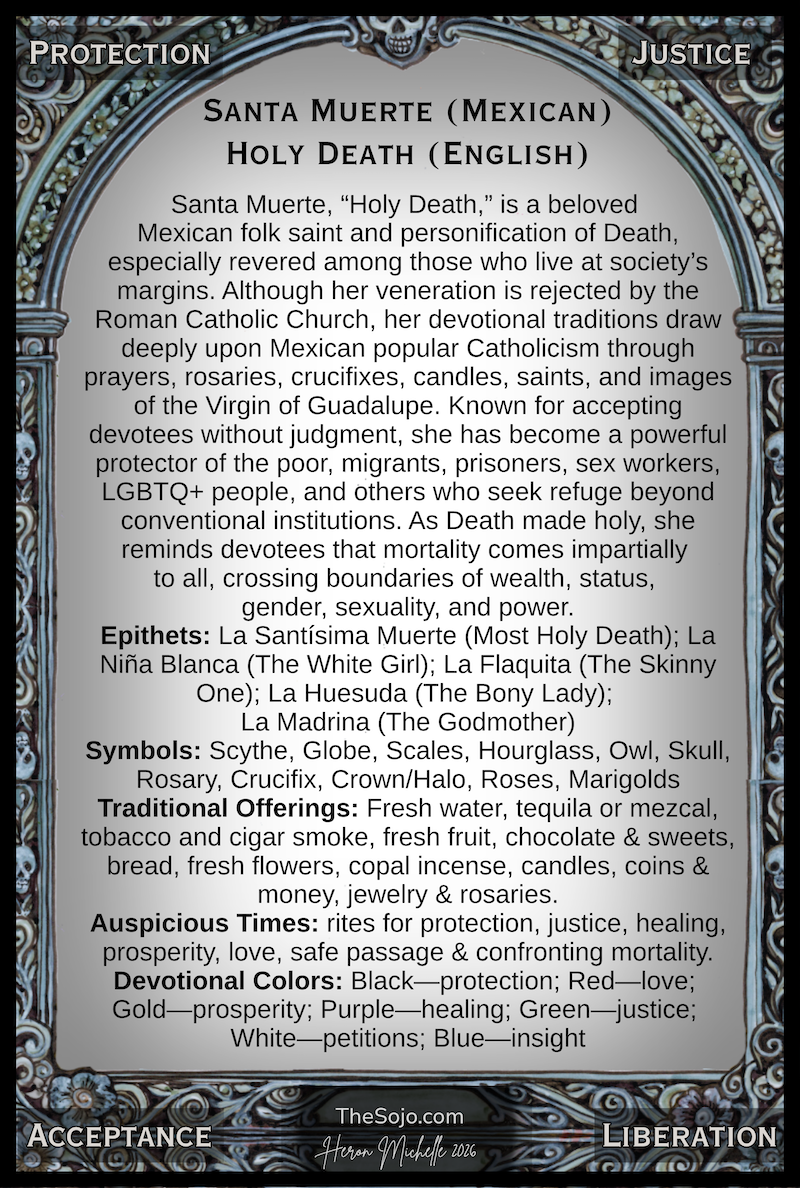 Image 2 of 2
Santa Muerte Altar Card in color on both sides of high quality matte card stock, 4”x6”.
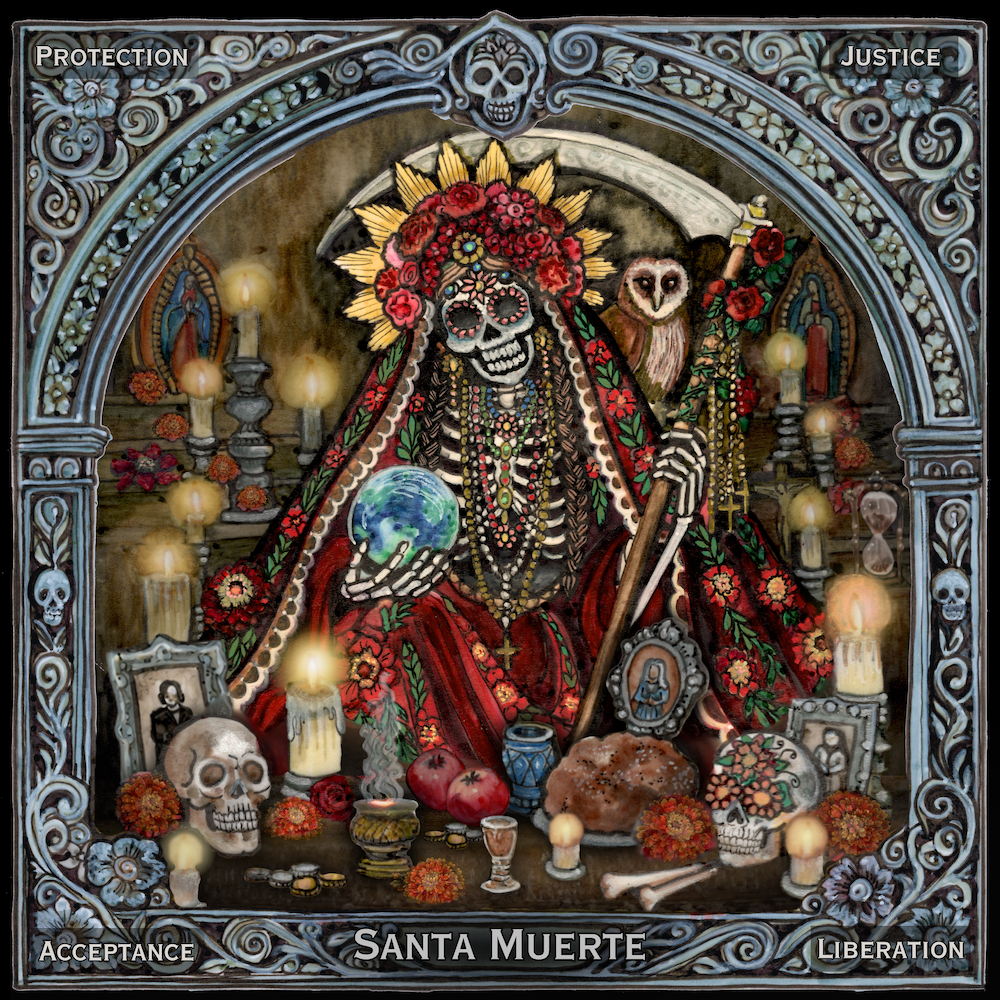
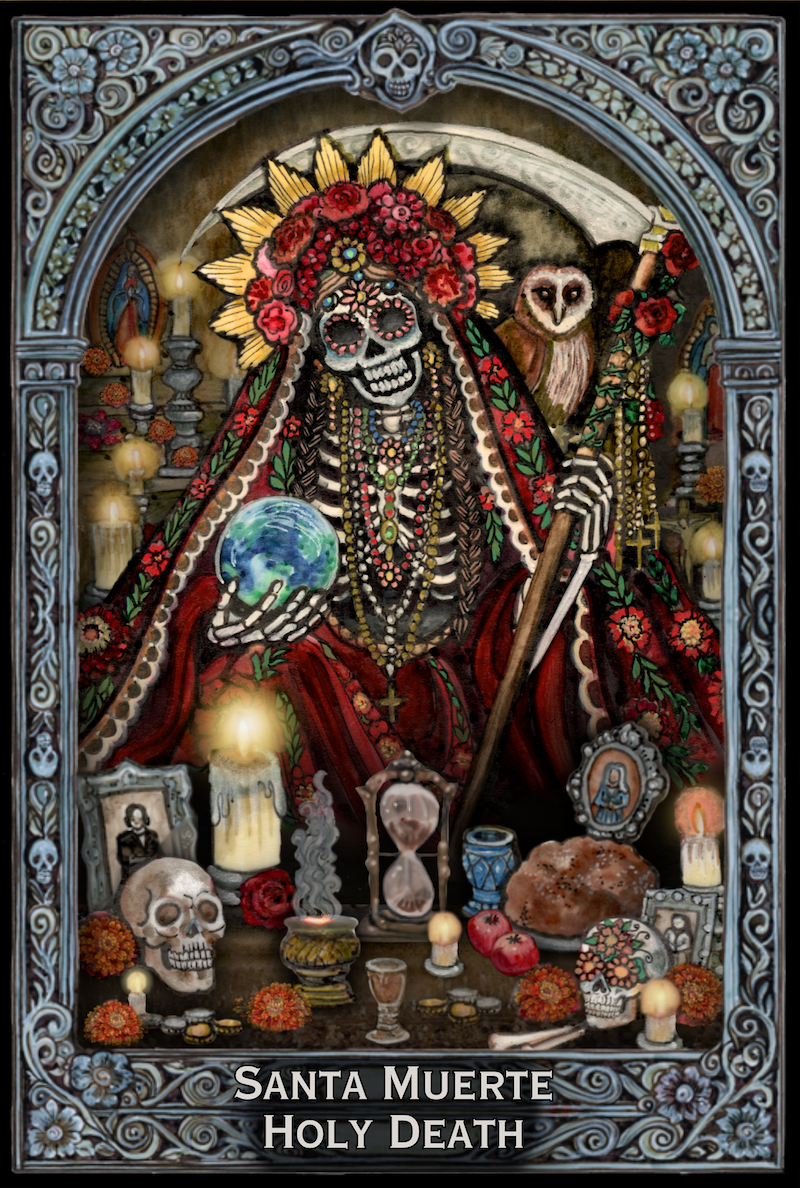
This original devotional artwork honors Santa Muerte—Holy Death, a beloved Mexican folk saint and personification of Death. I created the original illustration by hand in ink and paint on vellum, building the image in layers that were later integrated using canva digital software.
Santa Muerte appears enthroned within a candlelit shrine, crowned in roses and radiant golden rays and draped in elaborately embroidered robes. She bears her traditional scythe and globe, accompanied by the owl, hourglass, skulls, rosaries, crucifix, and images of the Virgin of Guadalupe. Her altar overflows with offerings drawn from contemporary Santa Muerte devotion and Mexican traditions of remembrance: candles, copal smoke, tequila, fresh fruit, bread, coins, flowers, roses, and brilliant orange marigolds.
I wanted especially to honor the distinctly Mexican and popular Catholic context from which modern Santa Muerte devotion emerges. Although the Roman Catholic Church does not recognize or approve her veneration, many of Santa Muerte's devotees understand their practice through familiar Catholic forms of prayer, rosaries, saints, crucifixes, candles, and petitions. She has become particularly beloved among people who live at society's margins—including the poor, migrants, prisoners, sex workers, and LGBTQ+ communities—who may find in Holy Death a powerful protector who receives them without judgment. https://hemisphericinstitute.org/en/emisferica-13-1-states-of-devotion/13-1-essays/santa-muerte-saint-of-the-dispossessed-enemy-of-church-and-state.html
Keywords: Protection • Justice • Acceptance • Liberation.
The altar card expands upon her history and contemporary devotional traditions, including her epithets, sacred symbols, traditional offerings, and the meanings of the colored votive candles used by devotees.
Above all, I sought to portray Santa Muerte as Death made holy, rather than frightening or sinister: to me she is beautiful, inevitable, impartial, and welcoming. Before Holy Death, distinctions of wealth, status, gender, sexuality, and worldly power ultimately fall away. She reminds us that Death comes for us all—and that even at the threshold of mortality, we may encounter mystery, dignity, protection, and sacred acceptance.
Santa Muerte (Mexican)
Holy Death (English)
Santa Muerte, “Holy Death,” is a beloved Mexican folk saint and personification of Death, especially revered among those who live at society’s margins. Although her veneration is rejected by the Roman Catholic Church, her devotional traditions draw deeply upon Mexican popular Catholicism through prayers, rosaries, crucifixes, candles, saints, and images of the Virgin of Guadalupe. Known for accepting devotees without judgment, she has become a powerful protector of the poor, migrants, prisoners, sex workers, LGBTQ+ people, and others who seek refuge beyond conventional institutions. As Death made holy, she reminds devotees that mortality comes impartially to all, crossing boundaries of wealth, status, gender, sexuality, and power.
Epithets: La Santísima Muerte (Most Holy Death); La Niña Blanca (The White Girl); La Flaquita (The Skinny One); La Huesuda (The Bony Lady); La Madrina (The Godmother)
Symbols: Scythe, Globe, Scales, Hourglass, Owl, Skull, Rosary, Crucifix, Crown/Halo, Roses, Marigolds
Traditional Offerings: Fresh water, tequila or mezcal, tobacco and cigar smoke, fresh fruit, chocolate & sweets, bread, fresh flowers, copal incense, candles, coins & money, jewelry & rosaries.
Auspicious Times: rites for protection, justice, healing, prosperity, love, safe passage & confronting mortality.
Devotional Colors: Black—protection; Red—love; Gold—prosperity; Purple—healing; Green—justice; White—petitions; Blue—insight
Santa Muerte Altar Card in color on both sides of high quality matte card stock, 4”x6”.
This original devotional artwork honors Santa Muerte—Holy Death, a beloved Mexican folk saint and personification of Death. I created the original illustration by hand in ink and paint on vellum, building the image in layers that were later integrated using canva digital software.
Santa Muerte appears enthroned within a candlelit shrine, crowned in roses and radiant golden rays and draped in elaborately embroidered robes. She bears her traditional scythe and globe, accompanied by the owl, hourglass, skulls, rosaries, crucifix, and images of the Virgin of Guadalupe. Her altar overflows with offerings drawn from contemporary Santa Muerte devotion and Mexican traditions of remembrance: candles, copal smoke, tequila, fresh fruit, bread, coins, flowers, roses, and brilliant orange marigolds.
I wanted especially to honor the distinctly Mexican and popular Catholic context from which modern Santa Muerte devotion emerges. Although the Roman Catholic Church does not recognize or approve her veneration, many of Santa Muerte's devotees understand their practice through familiar Catholic forms of prayer, rosaries, saints, crucifixes, candles, and petitions. She has become particularly beloved among people who live at society's margins—including the poor, migrants, prisoners, sex workers, and LGBTQ+ communities—who may find in Holy Death a powerful protector who receives them without judgment. https://hemisphericinstitute.org/en/emisferica-13-1-states-of-devotion/13-1-essays/santa-muerte-saint-of-the-dispossessed-enemy-of-church-and-state.html
Keywords: Protection • Justice • Acceptance • Liberation.
The altar card expands upon her history and contemporary devotional traditions, including her epithets, sacred symbols, traditional offerings, and the meanings of the colored votive candles used by devotees.
Above all, I sought to portray Santa Muerte as Death made holy, rather than frightening or sinister: to me she is beautiful, inevitable, impartial, and welcoming. Before Holy Death, distinctions of wealth, status, gender, sexuality, and worldly power ultimately fall away. She reminds us that Death comes for us all—and that even at the threshold of mortality, we may encounter mystery, dignity, protection, and sacred acceptance.
Santa Muerte (Mexican)
Holy Death (English)
Santa Muerte, “Holy Death,” is a beloved Mexican folk saint and personification of Death, especially revered among those who live at society’s margins. Although her veneration is rejected by the Roman Catholic Church, her devotional traditions draw deeply upon Mexican popular Catholicism through prayers, rosaries, crucifixes, candles, saints, and images of the Virgin of Guadalupe. Known for accepting devotees without judgment, she has become a powerful protector of the poor, migrants, prisoners, sex workers, LGBTQ+ people, and others who seek refuge beyond conventional institutions. As Death made holy, she reminds devotees that mortality comes impartially to all, crossing boundaries of wealth, status, gender, sexuality, and power.
Epithets: La Santísima Muerte (Most Holy Death); La Niña Blanca (The White Girl); La Flaquita (The Skinny One); La Huesuda (The Bony Lady); La Madrina (The Godmother)
Symbols: Scythe, Globe, Scales, Hourglass, Owl, Skull, Rosary, Crucifix, Crown/Halo, Roses, Marigolds
Traditional Offerings: Fresh water, tequila or mezcal, tobacco and cigar smoke, fresh fruit, chocolate & sweets, bread, fresh flowers, copal incense, candles, coins & money, jewelry & rosaries.
Auspicious Times: rites for protection, justice, healing, prosperity, love, safe passage & confronting mortality.
Devotional Colors: Black—protection; Red—love; Gold—prosperity; Purple—healing; Green—justice; White—petitions; Blue—insight