Now taking pre-orders — shipping by September 30, 2026
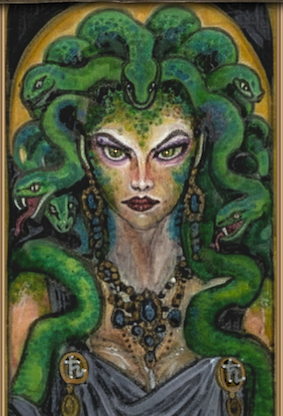
4" × 6" full-color devotional altar card, featuring original artwork on the front and a concise guide to Medusa’s mythology, magickal intentions, devotional offerings, and Hermetic correspondences on the reverse.
Original artwork, writing, and design by Heron Michelle.
Medusa, the famous Gorgon of Greek mythology, has become a powerful modern symbol of sovereignty, boundaries, protection, and righteous fury. Yet the Medusa depicted in this original artwork reaches beyond the familiar Roman story of a beautiful woman transformed into a monster. In Hesiod’s much earlier Theogony, Medusa is a Gorgon by birth, daughter of the ancient sea divinities Phorkys and Keto and granddaughter of Gaia and Pontos—Earth and Sea. Of the three Gorgon sisters, Medusa alone is mortal, yet her terrible power survives even death.
Her image became one of the ancient Mediterranean world’s most recognizable apotropaic emblems. The gorgoneion, the staring face of the Gorgon, appeared upon temples, armor, jewelry, vessels, and funerary monuments as an image intended to avert danger: a terrifying guardian whose unwavering gaze turns threatening forces away.
This original altar-card design by Heron Michelle draws upon that ancient protective symbolism while developing Medusa through a modern Witchcraft and Hermetic framework as The Gorgon, Defender of Sovereignty.
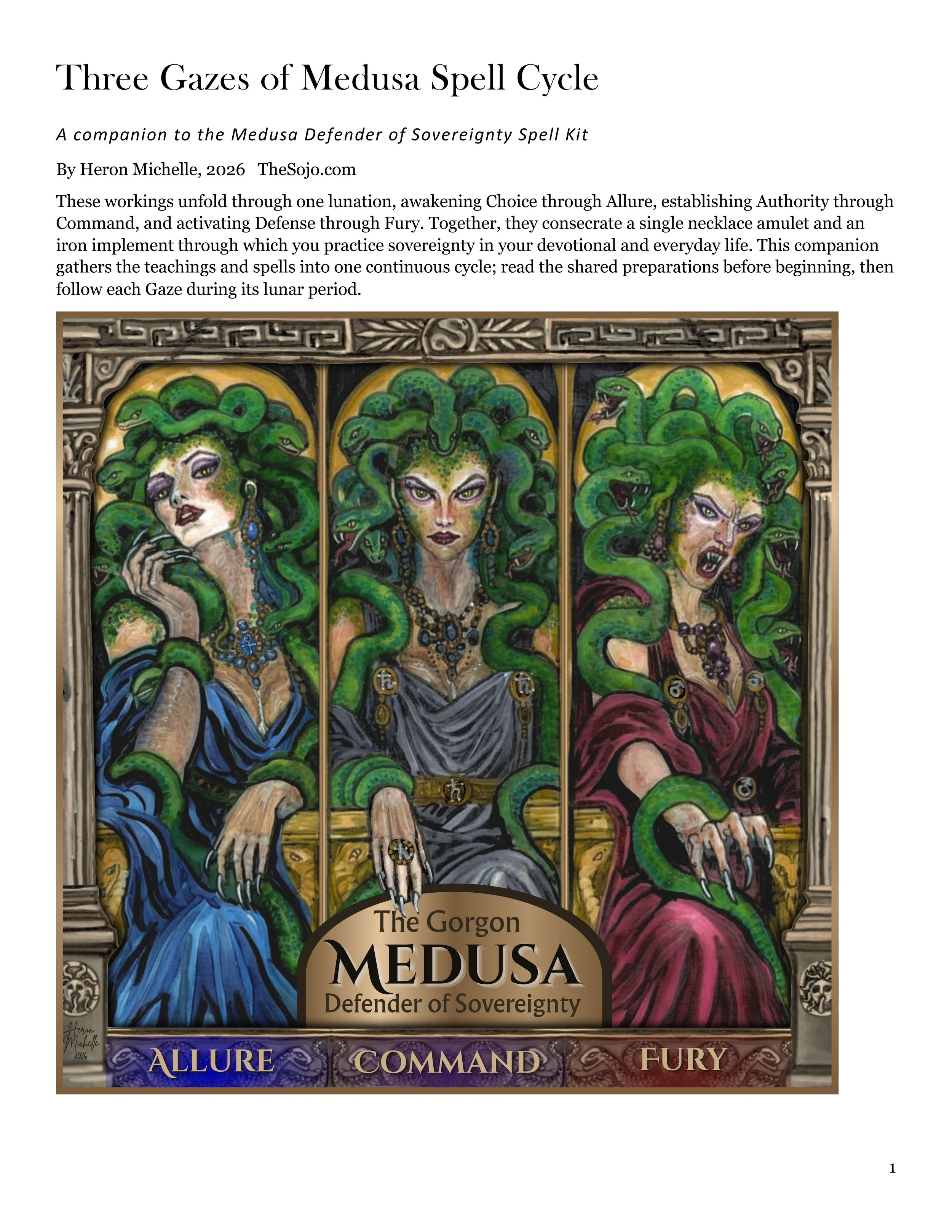
Medusa appears in three aspects, each associated with a different magickal intention and planetary influence: Allure • Venus • Choice, the sovereign power to choose how we are seen and whom we welcome into our sphere; Command • Saturn • Authority, the power to establish boundaries and determine what is permitted within our domain; and Fury • Mars • Defense, the power to actively defend those boundaries when they are violated.
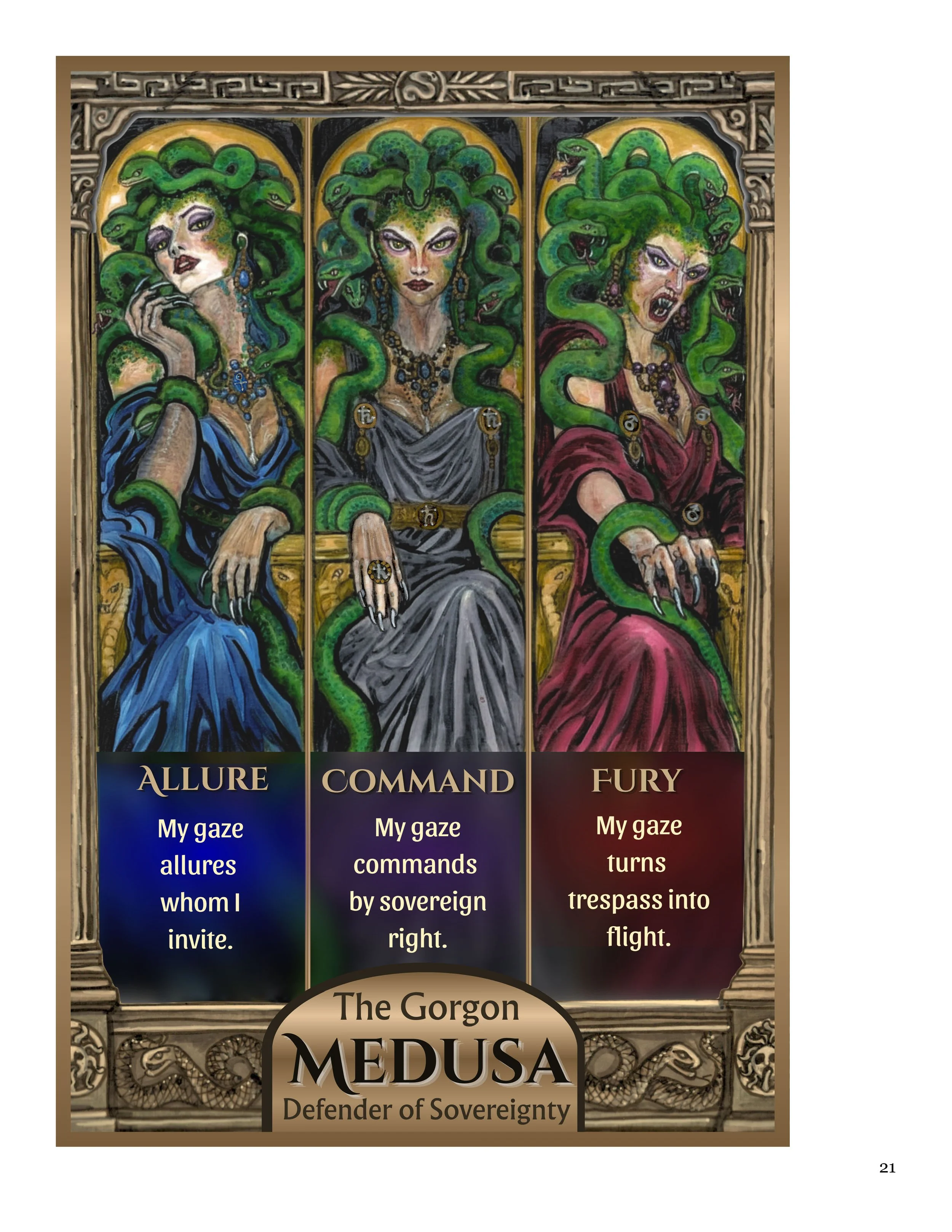
The front of the card depicts all Three Gazes of Medusa together—Allure, Command, and Fury—and includes a three-part charm for invoking their powers:
My gaze allures whom I invite.
My gaze commands by sovereign right.
My gaze turns trespass into flight.
The reverse offers a compact devotional and spellwork reference, including Medusa’s Greek lineage and the ancient apotropaic function of the gorgoneion; magickal intentions for Sovereignty, Consent, Self-Possession, Boundaries, Protection, Courage, Defiance, and Righteous Fury; and affirmations for working with each of the Three Gazes.
The card also includes Hermetic correspondences for Venus, Saturn, and Mars, with gemstones, metals and minerals, botanical allies, and planetary days, as well as suggested offerings for modern devotional practice.
Display the card upon your altar as an image of Medusa, use it as a focus for meditation or spellwork, or pair it with the coordinating Three Gazes of Medusa Spell Candle Wrap. Together, the Three Gazes offer a progression of sovereign power: choose what you welcome, establish the terms of your domain, and defend its boundaries when necessary.
Her expression may change, but Medusa’s gaze never yields.
Now taking pre-orders — shipping by September 30, 2026
4" × 6" full-color devotional altar card, featuring original artwork on the front and a concise guide to Medusa’s mythology, magickal intentions, devotional offerings, and Hermetic correspondences on the reverse.
Original artwork, writing, and design by Heron Michelle.
Medusa, the famous Gorgon of Greek mythology, has become a powerful modern symbol of sovereignty, boundaries, protection, and righteous fury. Yet the Medusa depicted in this original artwork reaches beyond the familiar Roman story of a beautiful woman transformed into a monster. In Hesiod’s much earlier Theogony, Medusa is a Gorgon by birth, daughter of the ancient sea divinities Phorkys and Keto and granddaughter of Gaia and Pontos—Earth and Sea. Of the three Gorgon sisters, Medusa alone is mortal, yet her terrible power survives even death.
Her image became one of the ancient Mediterranean world’s most recognizable apotropaic emblems. The gorgoneion, the staring face of the Gorgon, appeared upon temples, armor, jewelry, vessels, and funerary monuments as an image intended to avert danger: a terrifying guardian whose unwavering gaze turns threatening forces away.
This original altar-card design by Heron Michelle draws upon that ancient protective symbolism while developing Medusa through a modern Witchcraft and Hermetic framework as The Gorgon, Defender of Sovereignty.
Medusa appears in three aspects, each associated with a different magickal intention and planetary influence: Allure • Venus • Choice, the sovereign power to choose how we are seen and whom we welcome into our sphere; Command • Saturn • Authority, the power to establish boundaries and determine what is permitted within our domain; and Fury • Mars • Defense, the power to actively defend those boundaries when they are violated.
The front of the card depicts all Three Gazes of Medusa together—Allure, Command, and Fury—and includes a three-part charm for invoking their powers:
My gaze allures whom I invite.
My gaze commands by sovereign right.
My gaze turns trespass into flight.
The reverse offers a compact devotional and spellwork reference, including Medusa’s Greek lineage and the ancient apotropaic function of the gorgoneion; magickal intentions for Sovereignty, Consent, Self-Possession, Boundaries, Protection, Courage, Defiance, and Righteous Fury; and affirmations for working with each of the Three Gazes.
The card also includes Hermetic correspondences for Venus, Saturn, and Mars, with gemstones, metals and minerals, botanical allies, and planetary days, as well as suggested offerings for modern devotional practice.
Display the card upon your altar as an image of Medusa, use it as a focus for meditation or spellwork, or pair it with the coordinating Three Gazes of Medusa Spell Candle Wrap. Together, the Three Gazes offer a progression of sovereign power: choose what you welcome, establish the terms of your domain, and defend its boundaries when necessary.
Her expression may change, but Medusa’s gaze never yields.

 Image 1 of 7
 Image 2 of 7
 Image 3 of 7
 Image 4 of 7
 Image 5 of 7
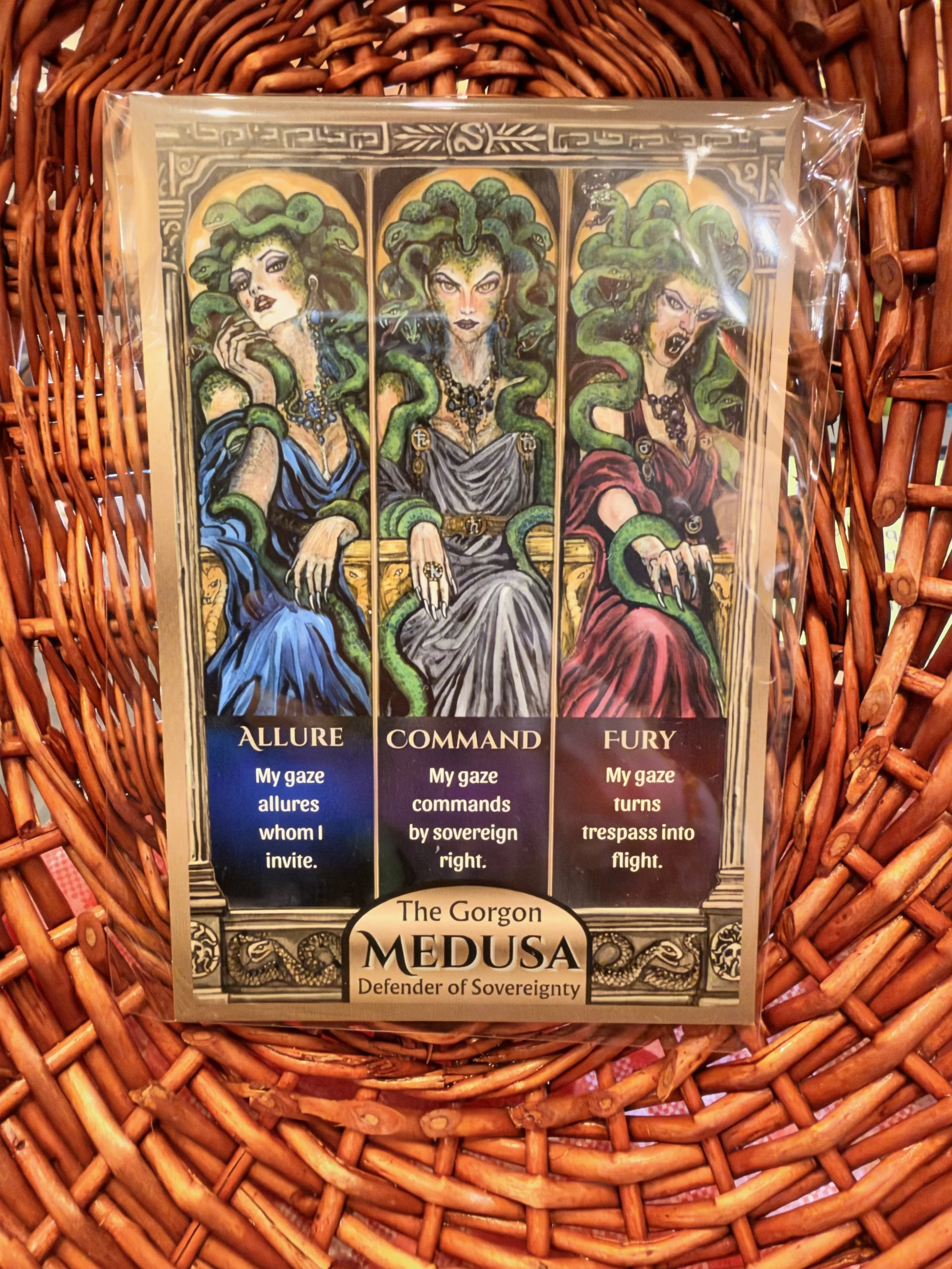 Image 6 of 7
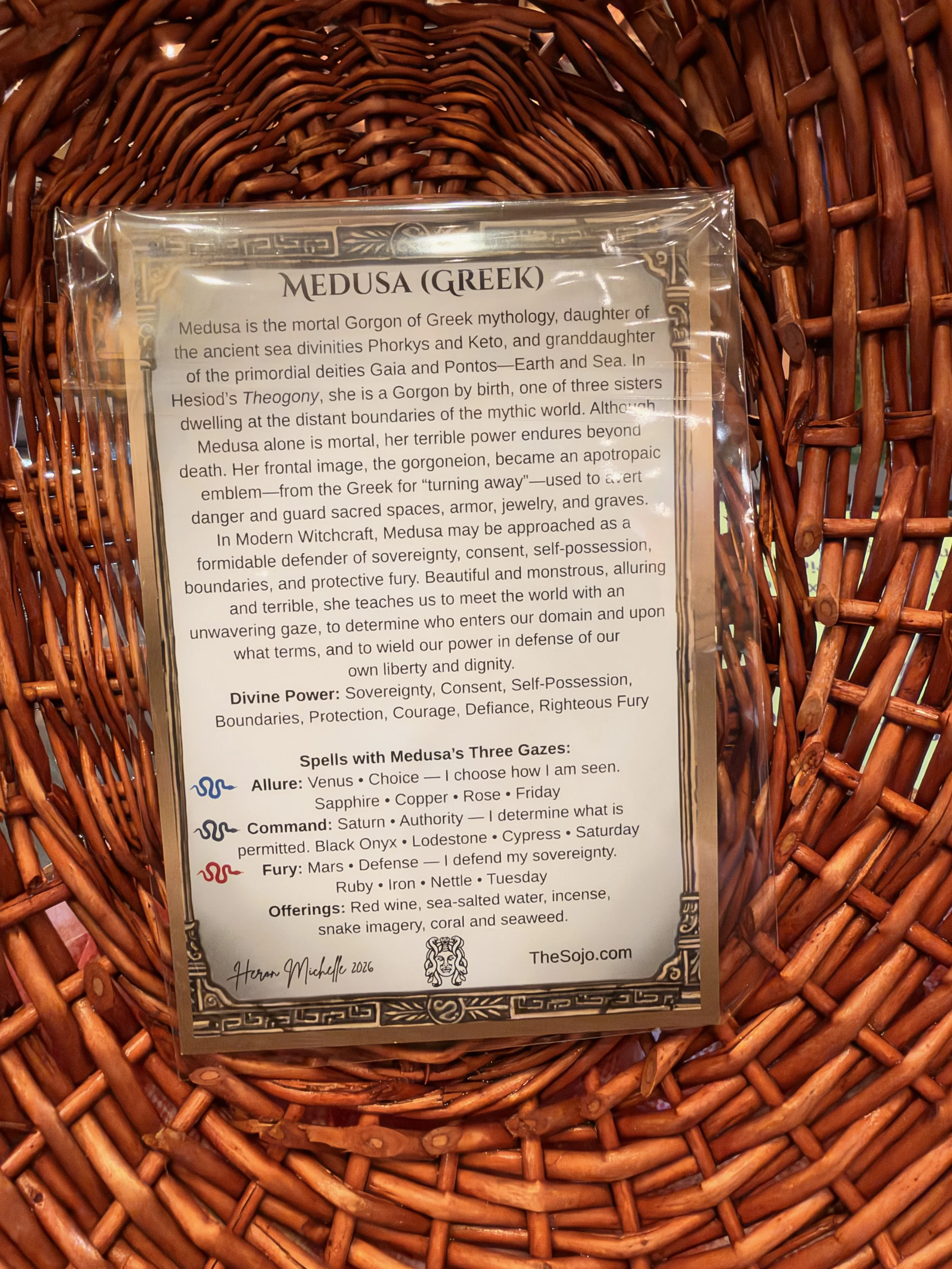 Image 7 of 7